
A new type of Design studio in the era of AI.
Strategy and design experts, bridging stakeholders across your business to harness the Human + AI potential.
Human + AI = Meaningful Impact
Challenges Today
Transformation in the Era of AI Means Going Deep Into Business Workflows, Guided by Human Experts
Enterprises need to evaluate their processes to implement AI effectively and leverage their strategic differentiation. The biggest challenge is not technological, but instead it is operational and institutional.
Generative AI, particularly in the form of AI Agents, promises scaled execution at a fraction of the cost of traditional business practices. Eager to capture this speed and efficiency, business leaders across industries are investing heavily to integrate AI into their workflows.
However, when it comes to detailed execution, many organisations hit a wall: they struggle to define exactly where and how to deploy AI.
Data in organisations live in digitised and non-digitised sources, in structured and unstructured formats. Data that exist today are mostly static records in siloed System of Records (e.g. ERP, CRM, etc.), emails, slack channels, and conversations. Very few organisations capture meanings behind the data, and even fewer do so in an organised and retrievable way. Data can be abstracted into knowledge, where meaning emerges and business value can be associated. The reason why we do things in a certain way and the implications if we don’t. We can discover knowledge in an organisation if we ask the right people, and unpack their way of thinking which we call “expertise”.
The root of the problem lies in capturing institutional knowledge. The vital "know-how" that resides with internal experts is notoriously difficult to translate into concrete requirement specifications. This institutional knowledge is critical for AI Agents to have, they need to understand the context to execute workflows correctly. Just like human employees who go through specific trainings. When mapping out processes for an AI transition, businesses frequently uncover several systemic issues:
Inconsistent Workflows: Teams often have conflicting understandings of the actual steps within a process.
Vague Ownership: There is frequently uncertainty over who is responsible for each specific step.
Fragile Logic: Logical decision models are often incomplete or poorly defined.
Undefined Boundaries: Organisations often lack alignment on exactly where a workflow starts and ends.
This internal friction is further compounded by the dense interdependency of multiple overlapping workflows.
Without first resolving these underlying process gaps, AI pilots predictably stall. When workflows are poorly defined or not standardised, the outputs of AI Agents that reference them for context, inevitably fall short of expectations. In some cases, we have seen employees use AI Agents individually without coordination, generating volumes of outputs that are myopic, creating confusion, frustration and friction with adjacent business functions.
Failing to define clean operational requirements before launching an extensive AI implementation program isn't just a technical risk, it is a recipe for catastrophic business failure.
Confidence in AI Results
Due to its probabilistic nature, AI products that will succeed aren’t necessarily those with the most advanced models, they’re the ones that engineer confidence and maximise CAIR.
CAIR =
Value of Success
(Perceived Consequence of Error X Effort to Correct)
Point of View
To Orchestrate AI Agents,
First We Must Orchestrate Knowledge
Shared and accessible organisational knowledge enables AI to execute with context and humans to focus their creativity on things that matter.
When an enterprise abstracts its data to extract deeper meaning, it lays the critical foundation for intentional AI implementation. For those willing to audit and capture their institutional knowledge, this period of reckoning is both a tactical necessity and a profound strategic opportunity.
In the near term, companies can unlock immediate growth by deploying AI Agents to execute existing processes accurately and at scale.
During this transition, a powerful secondary benefit emerges: as employees document their expertise and question why things are done a certain way, it naturally opens the door to workflow optimisation.
In the long term, this deep understanding of core operations allows businesses to pivot entirely, launching "AI-native" business models that capture entirely new value pools.
The era of AI also demands that we break down traditional organisational silos. Both human employees and AI agents must be able to traverse data seamlessly across Systems of Record to grasp true context and execute tasks with intelligence.
This is the future of work. By uniting across teams, employees can contribute their unique expertise to unlock tangible organisational value and find deeper purpose in their work.
Ultimately, by blending human imagination and exploration with the efficiency and speed of Agentic AI execution, businesses can fully leverage their legacy domain expertise to thrive in the AI era.

Knowledge Orchestration Principles:
Business users control their data. Business domain experts should be able to specify what matters and how concepts and rules relate to actions.
Digitised and shared knowledge in a semantic layer. Make it easy for non-technical employees to capture contextual knowledge so that data can be understood and used by AI as well as other employees.
Knowledge captured based on the value it generates. Capture knowledge only when there is a valid business value associated. Remain grounded on the vision and mission of the organisation.
Knowledge evolves at the speed of business. Contextual linkages change over time. Continuous evolution, management and governance of your institutional knowledge is what keeps your business competitive.
A new type of Design studio is needed to guide organisations in their AI transformation journey. A studio that can bridge strategy and design, align stakeholders across business functions and uses human-centricity, business and technology expertise to harness the Human + AI potential.
About Us
Design Studio in the Era of AI
We are a small network of experienced design leaders who are experts in strategy, digital product, service design, experience design, user research, business processes and technology. We are knowledge architects.
We are the catalyst for your AI Transformation.
We believe…
In Design with a capital “D”. We are problem-solving experts with a humanist lens and practical business sensibilities. We are generalists who are specialised in multiple areas. We are leaders without the ego, because we are genuinely curious. We build bridges with other experts and think strategically together. We create experiences and tools that never existed before. We identify opportunities to improve our society. We build the the right thing, in the right way, and then scale the good parts.
Design from the Surface to the Substrate of the AI Iceberg.
For enterprises in the era of AI, user-centricity is shifting from creating interactive screen experiences to defining how thinking systems should be designed to work together with humans.
Although human operated systems will continue to exist, the new battleground for design will be in knowledge architecture and orchestration. The focus will move from the tip of the iceberg towards to substrate. Where AI will execute, reason and act, at scale, on behalf of humans. This is where designers need to articulate, manage and measure institutional knowledge for neural network based probabilistic systems (AI) as well as human employees, so that the appropriate contexts are referenced in every transaction.
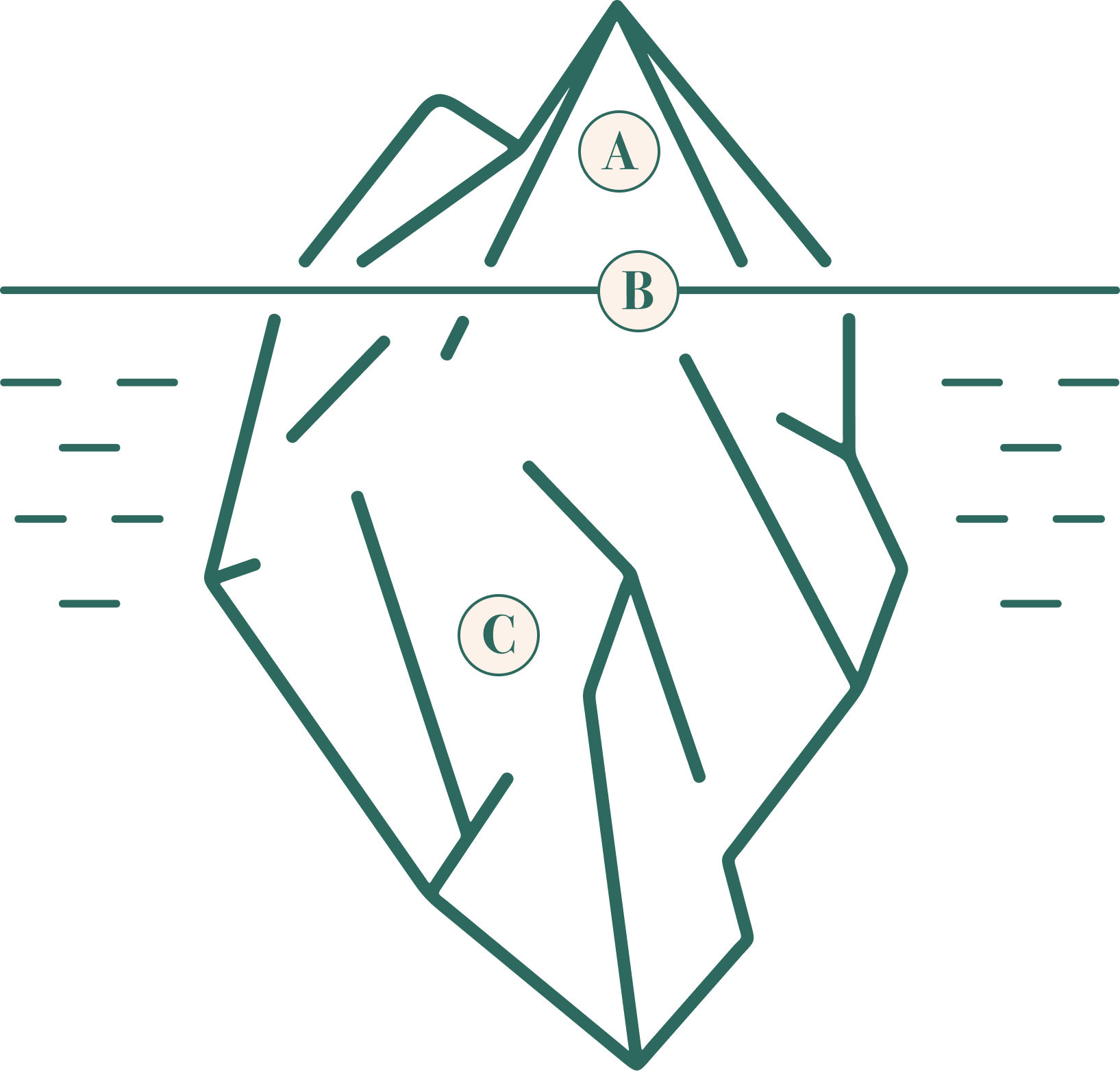
Modality Design
How humans interact with conventional and conversational interfaces at a personal level. Which modalities provide convenience, trust and clarity between humans and systems.
A
Orchestration Design
How human teams equipped with AI Agents, Assistants and platforms collaborate in seamless and connected ways. Designers map the contextual boundaries and service interactions across multiple teams, ensuring optimal information, data and value flows during operational runtime.
B
Intelligence Design
How the AI should learn - how it acquires, retains and use contextual knowledge of the organisation, functioning as the true value multiplier. Designers align stakeholders to define the ontology for the organisation, work with data engineers to abstract data into contextual knowledge, fine-tune business logics and help define new value models.
C
Paradeigma

(Greek: παράδειγμα, plural: paradeigmata)
Is an Ancient Greek term meaning “pattern”, “model”, “example” or “sample”.
Is a technique in Ancient Greek rhetoric used to compare the situation of the audience to a similar past event, like a parable (Greek: παραβολή). It offers counsel on how the audience should act. Aristotle was a prominent ancient rhetorician who explicitly discussed the use of paradeigmata.
It is the direct etymological root of the English word "paradigm".
Our Offerings

AI & Digital Transformation Consultancy
Opportunity Canvas
Value Tree
Experience Roadmap
Delivery Playbook
Envisioning Workshop
Stakeholder Map
Initiatives Portfolio
Dependency Matrix
Product Strategy
OKR & KPI
Engage expert advisory for your AI & Digital Transformation programs.
Align C-level stakeholders on vision, goals and measurements while generating impactful ideas in an Envisioning Workshop.
Set the right product oriented mindset, value-based judgement and measurable outcomes.
A compressed strategic engagement to focus on portfolio and product differentiation and impact.
Based on Design Thinking, Lean Start-up and Agile Delivery frameworks.
Experience Design & Service Design Consultancy
User Research & Insights
Service Blueprint
Ecosystem Map
Product Requirements
Prototype
Heuristic Analysis
Engage expert advisory to improve your customer and employee experience.
Evaluate cross-domain interconnected workflows to improve your brand experience across online and offline touch points.
Heuristic analysis of digital experience touch points. Prototype and develop impactful digital products.
Define service experience requirements, balancing stakeholder mindset, motivation factors and cultural norms.
Understand interdependencies of business functions and discover new opportunities from process improvement.
Ontology and Information Design Consultancy
Information Architecture
Context Graph
Ontology
Taxonomy
Content Model
Service to Channels Map
Operating Model
Design System
Engage expert advisory to codify institutional knowledge and scale AI implementation.
Define your organisation’s unique ontology, align understanding across functional stakeholders.
Go beyond AI governance workshops and define how AI understands context in practice. Embed relevant information such as policies, regulations, contracts, corporate decisions, etc. into AI executed processes, consistently across the organisation.
Create AI readable artefacts that reflect your business model, organisational culture and operational differentiation.
Uncover gaps in institutional knowledge and discover opportunities for new AI based operating models.
Meridian - Enterprise Semantic Platform
Advisory
Digital Product
A digital product to capture and configure your enterprise semantic layer. Integrate your data sources to effectively orchestrate AI agents with consistent context at speed and scale.
MVP release planned in Q3 2026.
At Paradeigma, we believe in keeping limited number of engagements at any given time, allowing us to provide meaningful problem solving expertise and deep advisory service for each client. The best programs begin with the right conversation.
Leadership Profile

Ari Widjanarko
Founder & Principal
A strategy and design leader with over 25 years of experience across North America and Asia, working across sectors including government, financial services, telecommunications, logistics, retail, and luxury. Ari specialises in systems thinking, human-centered design, and digital product strategy, with a strong track record of translating complex organisational and human insights into clear product visions, scalable operating models, and measurable outcomes.
Ari previously served as Design Principal and Associate Partner at IBM Consulting, where he was part of the ASEAN regional leadership team and led the Enterprise Experience Design Practice. Across Singapore, Thailand, Indonesia, and Malaysia, Ari oversaw a team of 53 practitioners while driving strategic design delivery and business growth. He was also a founding member of IBM iX in Singapore and ASEAN, where he established experience strategy and design capabilities and secured key regional accounts including DBS Bank, Siam Commercial Bank, DHL, MINDEF, MAS, MOHH, Shiseido and Electrolux.
Prior to IBM, Ari worked at Publicis Sapient, leading strategy and experience design engagements across the APAC region for clients such as Citibank, Credit Suisse, and MetLife. He also founded an information design consultancy, Pericraft, in New York City before relocating to Singapore to establish its Asia practice.















Contact Us
7 Leedon Heights, D’Leedon, Singapore 267953